
Art Radar #15: Effacement
Traces and transfers in the work of three contemporary artists

At this year’s Venice Film Festival—review coming very soon—I’ve seen at least three movies where a character’s absence was taking up more visual and mental space than the ones actually present. Film, just like literature, has that special ability to render something or someone that, in the diegetic present, is no longer there. This may or may not be related, but lately I’ve been thinking about the different forms of erasure, not as an accident or as the aftermath of forgetting, but as an act, a strategy. In other mediums as well, such as painting or photography, choosing what to or not to show is, in itself, part of the approach—and so is representing faintly, vanishingly, in a washed-out manner. One of the particular kinds of effacement was recently explored at the Musée d’Orsay under the form of blurring. Their recent exhibition Dans le flou, une autre vision de l’art de 1945 à nos jours, which I wrote about here, explored the use of blur throughout art history, passing through historical painterly movements and to the very current—post-WWII—concern of expressing the inexpressible, used in this way by artists like Gerhard Richter to painterly convey unthinkable realities such as genocide.
The show ended with quite recent works, but it still left me curious about how different techniques with a similar concealing effect might be used by young artists today, and what their plastic choices might mean in the time to which they, and we, belong. This is how I came up with this selection of three contemporary artists, who might not all use or relate directly to erasure per se, but in whose works I have found hints of fading, softening, or sometimes dissolution.
Sadie Whelan is an emerging artist from Tāmaki Makaurau, Aotearoa (and also how I got to know that this is the Maori name for Auckland, New Zealand). She employs gel medium transfer, a technique that relies on the properties of acrylic polymer emulsion—the same binder found in acrylic paints, but without added pigment. When applied to a surface such as plywood, gel medium can act as an adhesive and receptive ground for transferring an image. Typically, a photocopy or laser-printed image is pressed face-down into the gel. Once the surface has dried, the paper backing is carefully rubbed away with water, leaving the ink embedded in a thin, transparent film of acrylic. The result is rarely a perfect copy: sections of the image often fail to adhere, producing gaps, scratches, or other remnants. For her work Overlap (here on the left), the choice of plywood as a support is just as significant. Unlike canvas, which flexes and absorbs inconsistently, wood provides a rigid, durable ground. Its visible grain can also interact with the transparency of the gel, so that the support itself becomes part of the image. The image appears not simply laid upon the surface, but absorbed into it, fusing printed fragment and organic texture.
This process, to me, embodies a particular poetics of effacement. In Derridean thought—although his focus in works like De la grammatologie or L’écriture et la différence is on writing and linguistics— every sign bears within it the absence of what it cannot fully carry. The transferred image, never whole and often scarred, materializes this logic of writing-through-loss. It is legible precisely because of its incompleteness. In her Instagram caption for Overlap, Whelan mentions how the photograph used for the work was taken by her as a teenager, “thinking of Aotearoa and Avondale and loving rubbish and being angsty.” This experience of trash and angst, and even more so its memory, is emphasized by the washed-out look achieved through gel transfer, just like the old posters I believe we all used to have in our rooms growing up, or any other piece of paper an angsty teen would crumple up and eventually forget about. The experience in itself could even be created by its own image that we conjure in retrospect. Like Derrida wrote, the trace “is not merely the disappearance of the origin; it means here (…) that the origin has not even disappeared, that it has never been constituted except retroactively by a non-origin, the trace, which thus becomes the origin of the origin.”1


Born in 1999 in Washington, D.C., Allen‑Golder Carpenter is an interdisciplinary artist whose work explores memory, identity, and cultural erasure—particularly those of Black communities—through sculpture, installation, text, and found materials. Their current exhibition, Sojourn, is on view until September 6 at the brutalist contemporary art complex in Antwerp, Belgium, called TICK TACK. Made up of a ground floor and a mezzanine, the space is filled with a fittingly brutalist sculpture ensemble downstairs—steel poles emerging from identical rectangular-shaped concrete blocks, standing tall and bearing carved inscriptions such as “Everything In Its Right Place,” “Unselfish Benevolent Patient Love,” or “Seeing God During Near Death Experience”—and with a selection of paintings on wooden panel upstairs, forming a site-specific installation. Here, I would like to focus on the latter.
According to the curatorial text, “Sojourn explores cycles of life, death, and reincarnation as a framework for thinking through history and the burden of its preservation. (…) What gets to be remembered? Who decides? And what forms can remembrance take?” I feel like a big part of the show’s originality resides precisely in that reflection on preservation—and, once again, this is materially achieved through the use of acrylic gel, ink, acrylic paint, paper & spray paint on wooden panel, allowing for a particularly layered, tactile, and visually rich surface. Thus, Carpenter plays with transparency, opacity, texture, and collage-like juxtapositions, which perfecty support the conceptual premises of the exhibition—a face, event, movement can be covered up, spray painted over, its image degraded, effaced. Works of 100 x 80 cm—the classic dimensions for European historical portraiture—show fadedly rendered portraits of personalities such as abolitionist militant Sojourner Truth, poetress Audrey Lorde, or Haitian revolutionary Toussaint Louveture, crucial historical figures who may not always (and surely not now) be presented as part of the canon.2
On one hand, as Roland Barthes suggested, such (almost) photographic representations point to a certain ça-a-été—what we see is the persistence of something already lost, already withdrawn.3 Such an understanding of representation as both presence and death resonates with acrylic transfer’s spectral quality. However, fact that despite all material alterations, these figures remain visible and even recognizable, beautifully points to “our collective struggle to hold onto truth in the face of erasure,” to paraphrase TICK TACK’s curatorial text once more. Works are weekly rotated in the exhibition space, allowing each and every one of them to get individual contemplation and recognition. On top of that, not only did Sojourner Truth inspire the title of the show, Carpenter’s performance persona is also named Sojourn.


Folke Ignestam is a Danish emerging artist whose paintings occupy a liminal space between the photographic, the painterly, and the spectral. Fragmented and often composed of multiple panels, they evoke the logic of photographic negatives, where light becomes dark, and our visual, chromatic world is turned inside out. Rendered with an airbrushed softness, the works recall archival photographs, radiographs, or surveillance imagery, depending on your piece of cake. Statuary figures reminding me of the eerie 2007 Doctor Who episode “Blink” emerge only to dissolve again in one another, caught between their hand-painted material presence and traces of the imagined referents they figuratively point to. In some compositions, schematic outlines of hands or faint diagrammatic forms gesture toward codified systems of knowledge, yet their clarity only heightens the strangeness of the often central negative images. Ignestam’s work can thus be situated within a lineage of contemporary painting concerned less with representation than with mediation itself. These are not images that tell us what to see, but images that question how seeing is structured—technologically, historically, and psychologically.
The real-life referents of these non-photographs, if they ever existed, are erased by the sign itself and even deemed irrelevant in its blurs, spectral outlines, and layered surface, through which the artist stages memory and perception as fragments that must be reconstructed, like traces retrieved from a damaged personal archive. Adding to that a little dose of Lynchian delirium, just how we like it.


In guise of a conclusion, since we talked Roland Barthes, let me show you a hidden gem I found—and touched with my own hands—at the Venice Biennale archives, where I was working earlier this week.
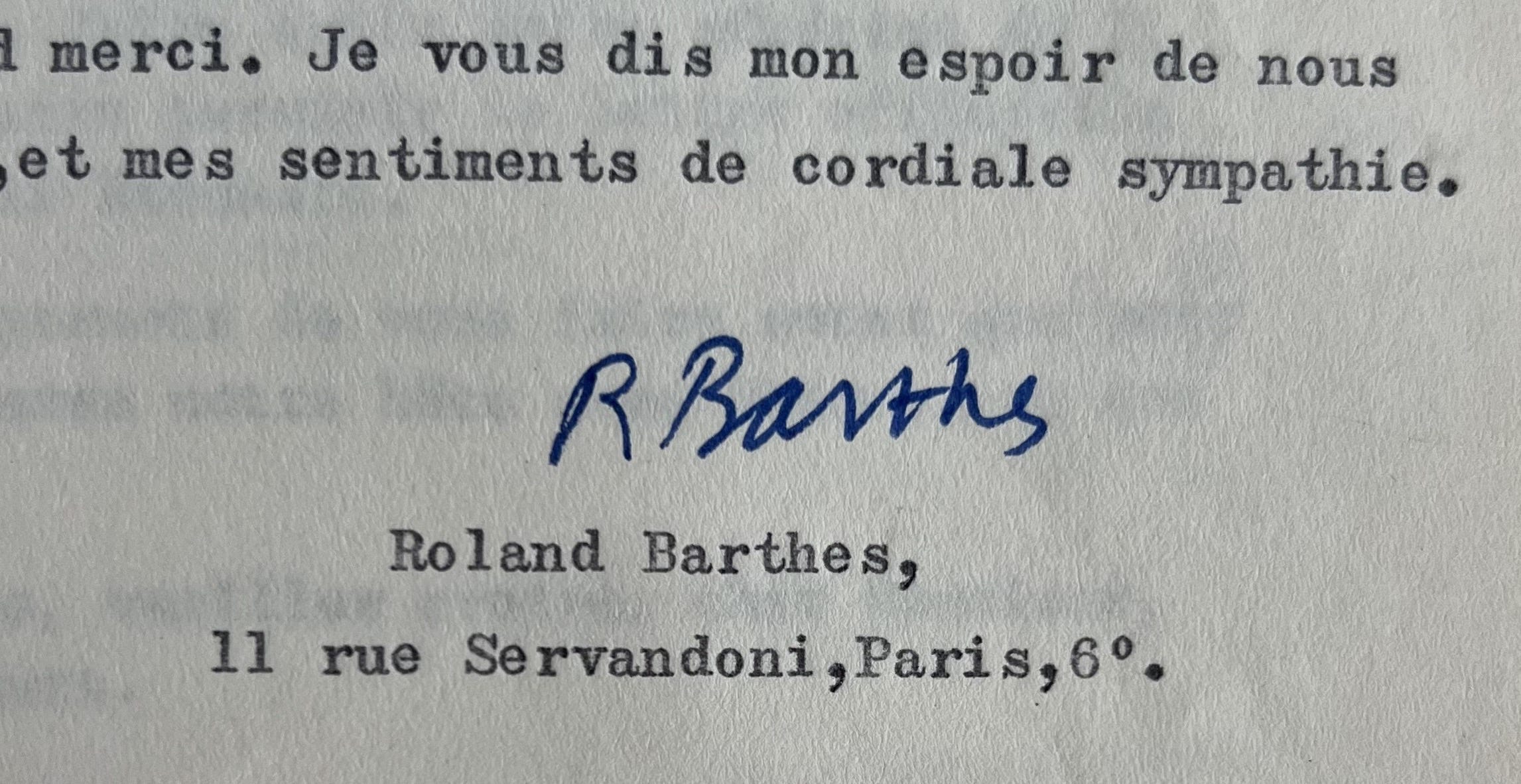
It was one of many, but I do find it important to briefly mention archives in a piece about erasure and the different forms it can take. To me, archival research—combined with writing, of course—is a not only important but also particularly enjoyable way of combatting the obscuring of history, or art history since we’re on that page. This work may in some cases be seen as socially useless, but in sifting through what survives and recreating traces, we do give the past a voice it might otherwise have lost. ∎
“La trace n'est pas seulement la disparition de l'origine, elle veut dire ici (…) que l'origine n'a même pas disparu, qu'elle n'a jamais été constituée qu'en retour par une non-origine, la trace, qui devient ainsi l'origine de l’origine.” Jacques Derrida, De la grammatologie (Paris, Les Éditions de Minuit, 1967), p. 90.
For more contemporary artists engaging with similar figures and histories, I wholeheartedly recommend a recently published book by one of my professors, Elvan Zabunyan, Réunir les bouts du monde: Art, histoire, esclavage en mémoire, Montreuil, B42, 2024.
Ideas developed by Roland Barthes in La Chambre claire : Note sur la photographie, Paris, Gallimard Seuil, 1980. Also known as Camera Lucida in its English translation.