
Studio Hangouts #3: Mathilde Badie
Rituals, material encounters, and food in contemporary curating

I met Mathilde Badie during our master’s program in Paris, where we bonded over our shared advisor (and, naturally, our shared passion for contemporary art). I admire her approach to curating, deeply engaged with artists, while also rigorous in her inquiries. Mathilde’s trajectory has taken her through various cultural spaces in France, while developing a curatorial practice that navigates ritual, materiality, and the politics of food. Currently in residence at Artagon Pantin, she’s embracing a more independent approach after years of working in collectives, exploring projects that bridge her academic research with curatorial experimentation. Here, we catch up to talk about her evolving practice, the challenges of working across different exhibition contexts, and what’s next for her.
Monica Seiceanu: Your curatorial research is deeply invested in ritual, materiality, and food. What initially drew you to these themes?
Mathilde Badie: I work on the relationship between belief and materiality because it reveals something about how we attempt to inhabit the world. I’m interested in matter in the broadest sense (objects, food, words...) and how it generates emotions, superstitions, and gestures. We imbue a lucky charm with protective powers, a food item with beliefs, a magic formula with supernatural effects… I find echoes of these questions in the work of many artists, whose practices develop methods of agency and challenge these biases.
M S: Your research trip with artist Emma Tholot is feeding into this upcoming project. Can you share more about that journey and what you’re working on?
M B: Emma Tholot is an artist whose theoretical and artistic research intersects with mine in multiple ways. This affinity became particularly clear when we visited the Mucem together and saw edible ex-votos in their collection. I suggested we pursue this line of inquiry through a trip to Calabria. There, we were able to train and learn both about artisanal practices and the rituals (both traditional and contemporary) surrounding them. We are now thinking about possible ways to share this work—perhaps an exhibition that is not documentary but rather conveys the plurality of people we met and the different layers of meaning involved, while also integrating her artistic practice and my research on the subject.


M S: How do you balance artistic and academic methodologies in your projects?
M B: Art history research informs my approach to contemporary creation, and vice versa—the two feed into each other like communicating vessels. Working with artists enriches my research by incorporating collective methodologies and research-creation approaches. The trip with Emma Tholot is a good example: we sought to understand an object both through contextual knowledge and through hands-on learning by making ex-votos ourselves.
M S: Your exhibitions incorporate elements beyond the visual, engaging performance and even culinary practices (which I personally enjoyed at Microplastic Diet back in November). How do you think about exhibition-making as an experiential process?
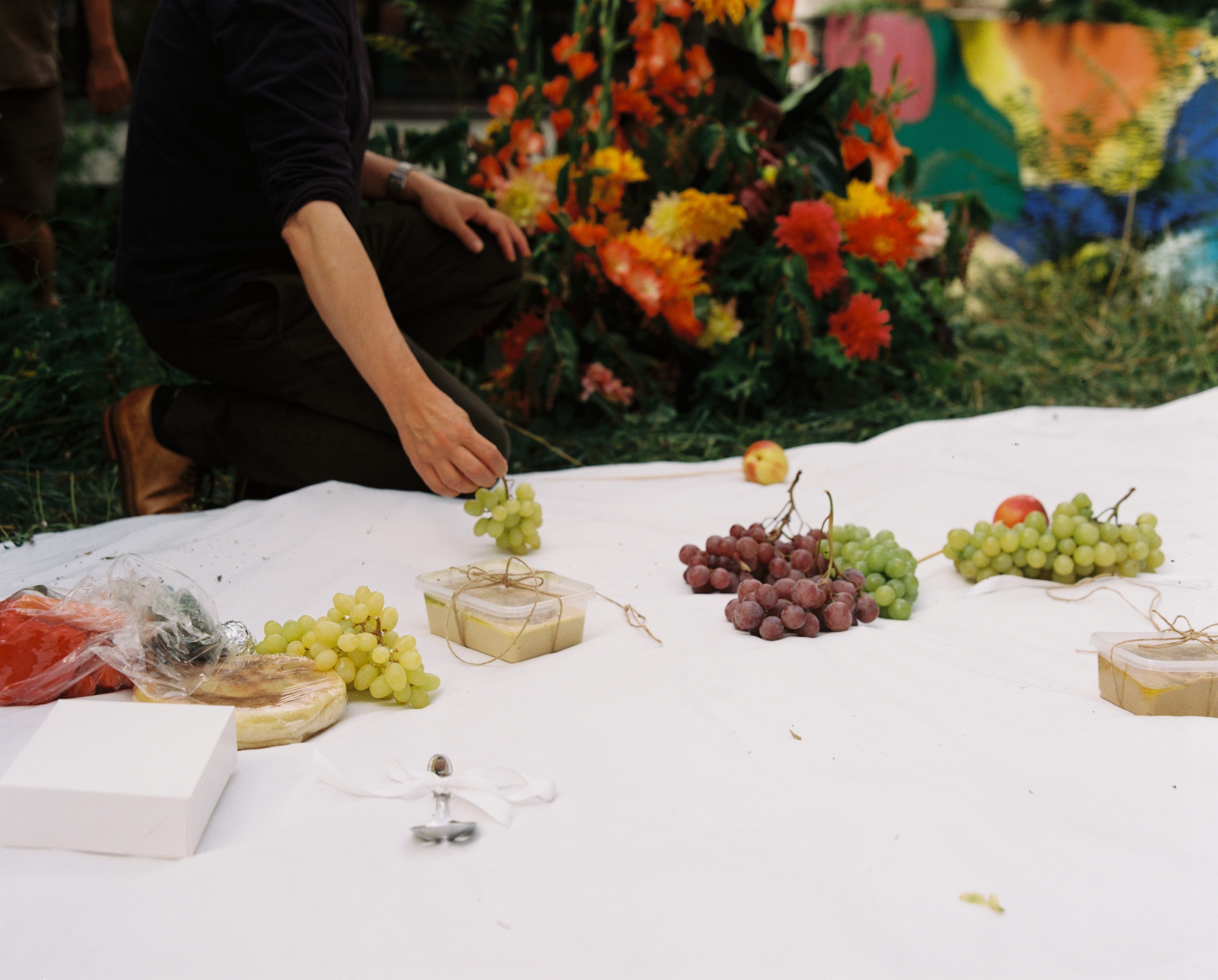
M B: Like many others, I believe an exhibition should be a space-time for encounters, exchanges, and reflection. I try to bring them to life through programming that often includes moments of conviviality and shared meals, inviting artists or collectives to organize banquets. The first was during the exhibition Après Vous, where Banquet Décadent (Yasmine Louali and Clémence Hoffmann) created Hunter Gatherer, a meal for forty participants, hunted and foraged from a garden, served on a massive tablecloth with tools sewn into it.
For Microplastic Diet at Tour Orion, which explored hybrid, processed, and chemically altered food, I designed an iconophagic feast—a snack where marshmallows bore the exhibition’s visual identity by Ismahane Poussin, biscuits featured its title, and colorful cakes were served. I was interested in the idea of making the exhibition itself edible, and in contributing with something myself—somewhat in the spirit of how Daniel Spoerri, at Restaurant de la Galerie J from 1963 and later at Restaurant Spoerri in Düsseldorf in 1968, sometimes pushed the "intermediaries" of art (critics and curators) to quite literally embody their role by serving food.


M S: You’re currently working on Sugar Rush, the next chapter of Microplastic Diet, as well as the collective show Very Superstitious—what connects these projects for you?
M B: The artists. I tend to work with the same people over time. I like that collaborations unfold across different formats—not always in the form of an exhibition. That’s where shared reflections emerge. For Sugar Rush, I’m working again with Yasmine Louali and Aurelia Casse, who were already part of Microplastic Diet. With Very Superstitious, I’m collaborating mostly with artists I’ve had ongoing conversations with for years, with whom I’ve worked on past projects, and who have become friends.
M S: At some point, you mentioned wanting to develop a seminar on food and the artistic practices that engage with it. What themes would you explore, and how do you envision your pedagogy for this subject?
M B: I would love to organize a seminar on the relationship between food and art, creating a space that connects contemporary art practitioners with academic researchers. I see it primarily as a way to give a platform to different voices, with each session bringing together people who work on similar themes but with different methodologies—for example, pairing a scholar researching cannibalism in art with an artist whose work is based on that concept.
M S: You’ve curated across student-led spaces, independent platforms, and institutional settings. What do you find most rewarding—and most challenging—about working within these different frameworks?
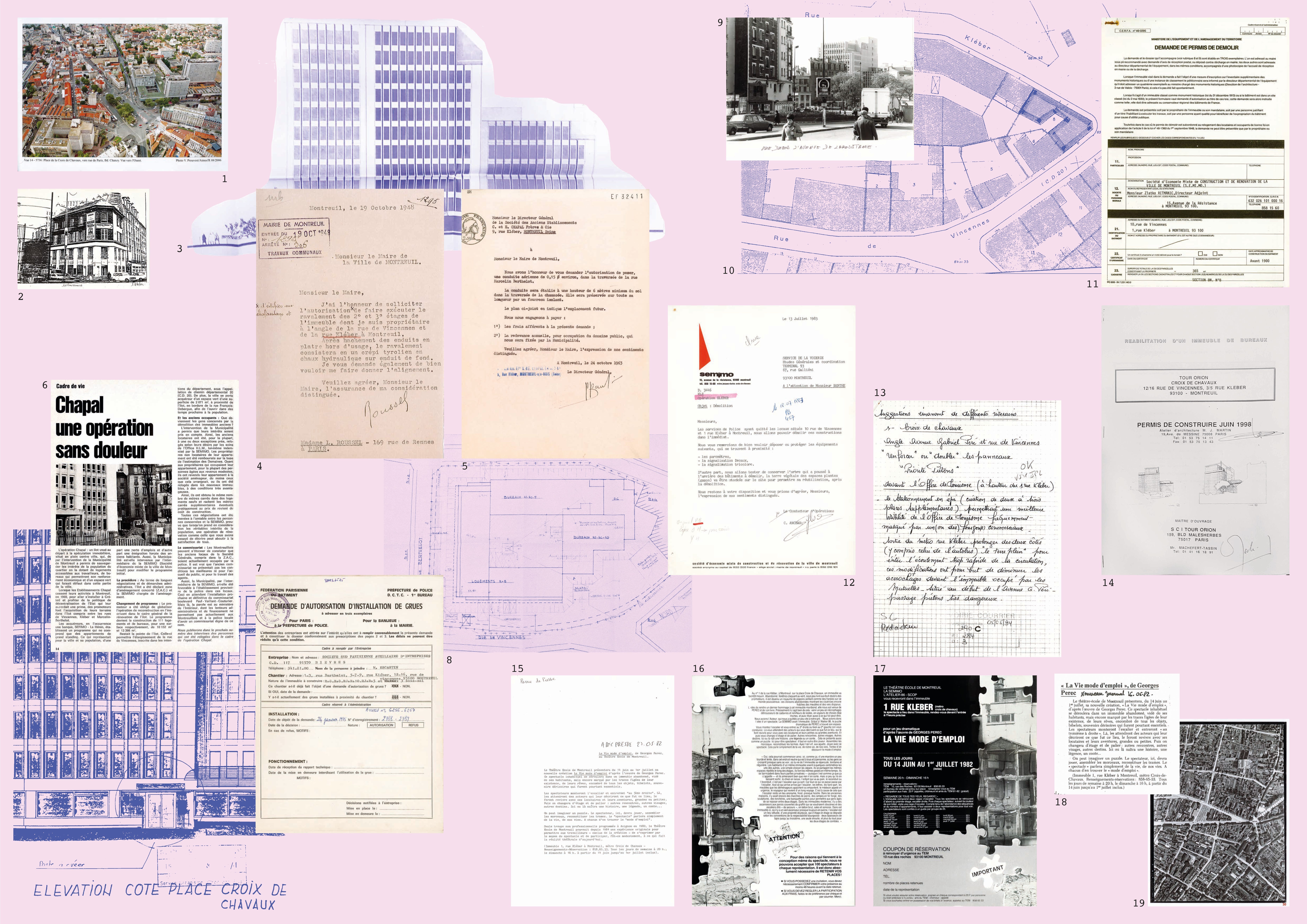
M B: I also see exhibition-making as an exercise, where the scale and scope emerge from constantly shifting conditions. Constraints—whether related to space, budget, artistic or institutional expectations, collective work, etc.—are interesting to me. For instance, during our residency at Tour Orion in 2024, Gabrielle Balagayrie and I chose to shape our exhibition (Soli Loci) around the site’s ephemeral and transitional nature, incorporating archival research into our approach. The site-specific aspect gave meaning to our project, but beyond that, I find that each exhibition’s material constraints push me in new directions.
M S: Residencies like Artagon play a role in shaping independent curatorial practices. What has this experience brought to your work?
M B: My residency at Artagon has provided valuable support, allowing me enough time to structure my practice and think about future directions. But the most enriching aspect is being part of a cohort representing such diverse fields—I intuitively and organically absorb elements from everyone’s practices just by being in contact with them.
M S: If you could organize an exhibition with no constraints, what would it look like?
M B: I’m obsessed with the idea of material archives, especially when events are ephemeral, performative, or involve food—things that are, by nature, perishable. So I would love for an exhibition to result in a publication. It could be both a catalog featuring interviews, collective texts, and traces of each programmed moment, as well as an object that reconstructs the curatorial project’s genesis. I envision a dense, hybrid publication that would reveal the different stages of shared research and work—functioning as an extension, a continuation of the exhibition itself. ∎